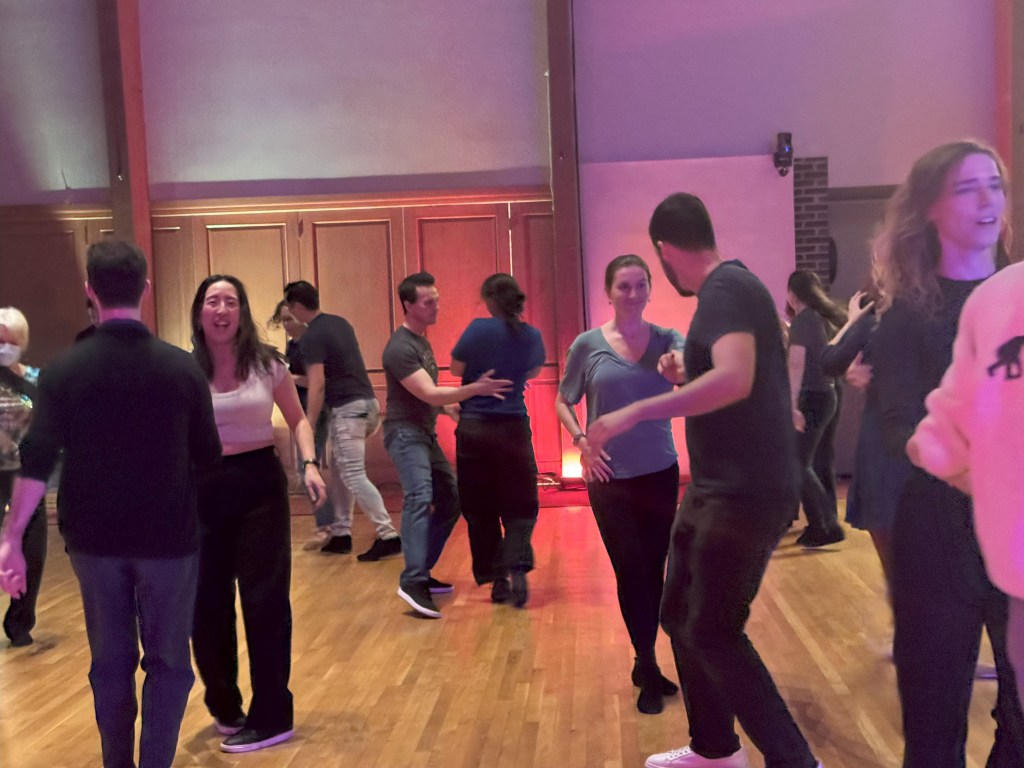
This page includes Beltway Connection policy and procedures outlining our code of conduct as well as what is involved with different levels of violations to ensure transparency.
Respect Boundaries
This applies to everything from close dance holds and dips to flirty conversation or just agreeing to dance. Just because someone does something with someone else, it doesn’t mean you are entitled to do it with them as well. If you are not sure about someone’s boundaries, ask them.
Ask & respond respectfully
We encourage every person to ask everyone to dance, but it is also okay for anyone to say “no” for any reason. If you are turned down for a dance, please respect the other person’s wishes. You are not owed an explanation. If at any point you feel uncomfortable or unsafe during a dance, you can ask for adjustments and/or stop before the end of the song.
Don’t teach on the social floor
We are all here to have fun! At karaoke, you wouldn’t stop someone in the middle of a duet to offer them singing tips, would you? Of course not. So please don’t “teach” or offer unsolicited feedback on the dance floor. Note: Requests for your own safety and comfort are not the same as unsolicited feedback and are encouraged to promote a safe environment.
Share the space
The dance floor is for everyone. Be mindful of sharing the space and respecting other’s space when you are on the dance floor.
Harrassment
We want our dance to be safe for everyone, regardless of race, age, sexual orientation, gender, disability, appearance, religion, skill level, or anything else. We do not tolerate harassment of any kind. Any situation which makes another person feel unsafe or uncomfortable to the point of being unable to enjoy the event is unacceptable and can be considered harassment. If you harass or threaten someone, you may be asked to leave.
On-site Violations vs. Off-site Violations
Most interpersonal conflict and code of conduct violations can be handled by referring specifically to behavior on-site at Beltway Connection events. This allows for clear, well-defined expectations to be set in a controlled environment. However, when off-site conduct reaches such an extreme that a reasonable person could consider themselves mentally or physically unsafe by the presence of another attendee, we reserve the right to enforce disciplinary measures as necessary to preserve the safety of all attendees. The standard for this is higher than on-site actions.
Example:
While at a dance, attendee A and attendee B have no conflict. But off-site, attendee A threatens or assaults attendee B on one or more occasions, leading attendee B to be concerned for their mental or physical well being. In this case, it would be appropriate to enforce disciplinary action on attendee A despite nothing occurring on-site at the dance.
When the target of such behavior involves someone who is unable to leave an area (such as organizers, staff, and volunteers), there is a higher degree of precaution because this person cannot just leave an area if they are uncomfortable because they have duties that need to be performed. It is therefore sometimes necessary for the person being issued the warning to exercise an additional degree of restraint/caution when attending those events.
Disciplinary Action
Violation Level 1
These violations are minor infractions that don’t rise to the level of a formal written warning. Most of the time, these sort of violations can be handled with an in person conversation about community expectations and a message or email acknowledging that the conversation took place. There is not a set limit to the amount of level 1 violations an attendee can receive, but if the behavior is not corrected, it may constitute escalating to a level 2 violation.
Violation Level 2
These are major violations that include a formal written warning and meeting with an event director. The written warning will detail the observed infractions that necessitated the formal warning being issued, as well as detailed expectations for behavior moving forward to stay in good standing. This document is not an admission of guilt, but instead an acknowledgement of receipt and must be signed and returned before the attendee can return to the dance. This level of violation may or may not include a temporary suspension. If an attendee receives two level 2 violations, they will automatically receive a temporary suspension, and may or may not include a permanent ban. If an attendee receives three level 2 violations, that will result in an immediate ban from future Beltway Connection events.
Violation Level 3 –
These are major violations that necessitate an immediate expulsion from the dance and ban to all future Beltway Connection events. This includes any or all actions that the event directors deem as an immediate threat to the health, safety, and/or well being of the community, but can also include repeated level 2 violations without the behavior being corrected.
While the above are guidelines, they cannot cover every situation that arises. Disciplinary action can vary situationally based on type & degree of behavior. This is up to the discretion of the dance directors.